National Centre of Excellence in Green Ports and Shipping
A collaborative platform between Ministry of Ports, Shipping and Waterways (MoPSW) and The Energy and Resources Institute (TERI)
National Centre of Excellence in Green Ports and Shipping
A collaborative platform between Ministry of Ports, Shipping and Waterways (MoPSW) and The Energy and Resources Institute (TERI)
National Centre of Excellence in Green Ports and Shipping
A collaborative platform between Ministry of Ports, Shipping and Waterways (MoPSW) and The Energy and Resources Institute (TERI)
Technology
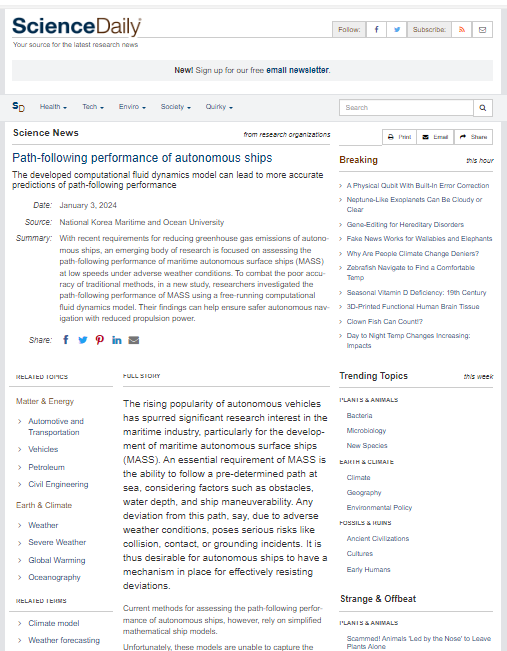
Path-following performance of autonomous ships
Author(s):
NA
Abstract:
A multinational team of researchers, led by Assistant Professor Daejeong Kim from the National Korea Maritime & Ocean University, has recently studied the path-following performance of Maritime Autonomous Surface Ships (MASS) using a free-running computational fluid dynamics (CFD) model combined with the line-of-sight (LOS) guidance system, at low speeds under adverse weather conditions. The study was motivated by the need for reducing greenhouse gas emissions of autonomous ships and assessing their path-following performance under adverse weather conditions. Traditional methods for assessing the path-following performance of autonomous ships rely on simplified mathematical ship models, which often lead to inaccurate estimates due to their inability to capture the complicated interactions between the hull, propeller, rudder, and external loads of ships. The researchers employed a CFD model based on a fully nonlinear unsteady Reynolds-Averaged Navier-Stokes solver that can incorporate viscous and turbulent effects and the free surface resolution critical to path-following problems. This approach enables a better prediction of path-following performance.