EnergySail: Wind & Solar Power for Low Emission Shipping
Author(s):
NA
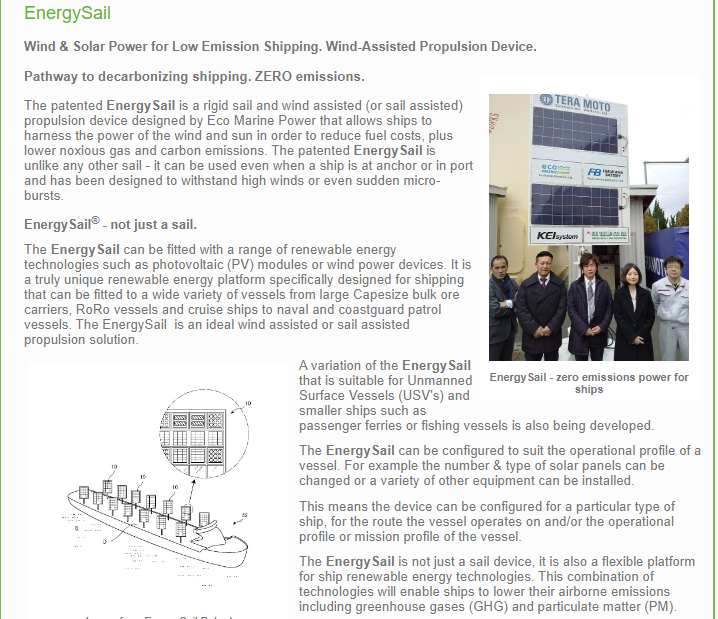
The patented EnergySail is a rigid sail and wind assisted (or sail assisted) propulsion device designed by Eco Marine Power that allows ships to harness the power of the wind and sun in order to reduce fuel costs, plus lower noxious gas and carbon emissions.
Integrated Rigid Sail & Solar Power System Zero Emissions Patented Technologies
Author(s):
NA
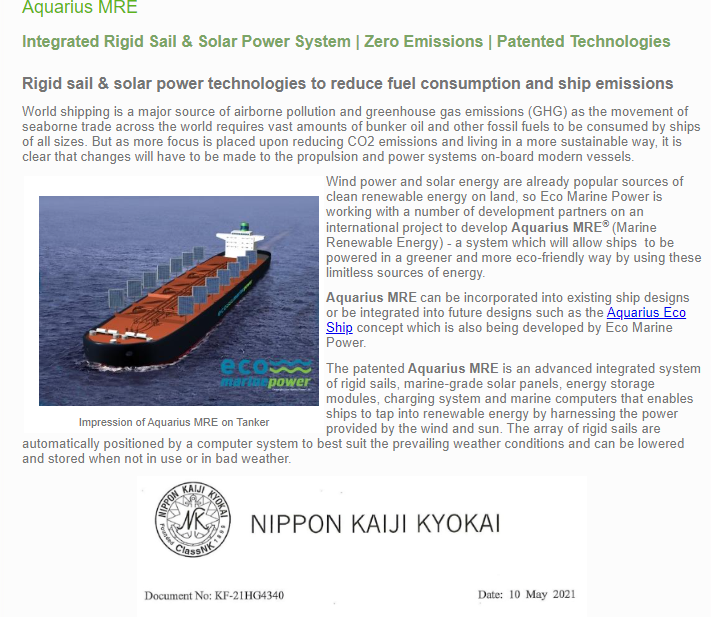
Aquarius MRE by Eco Marine Power is an innovative approach to using wind and solar power together on ships and the technology will help reduce fossil fuel consumption and noxious emissions across the shipping sector. It will also be a key technology in terms of helping to de-carbonize shipping.
Innovation for Low Carbon Shipping and Marine Applications
Author(s):
NA
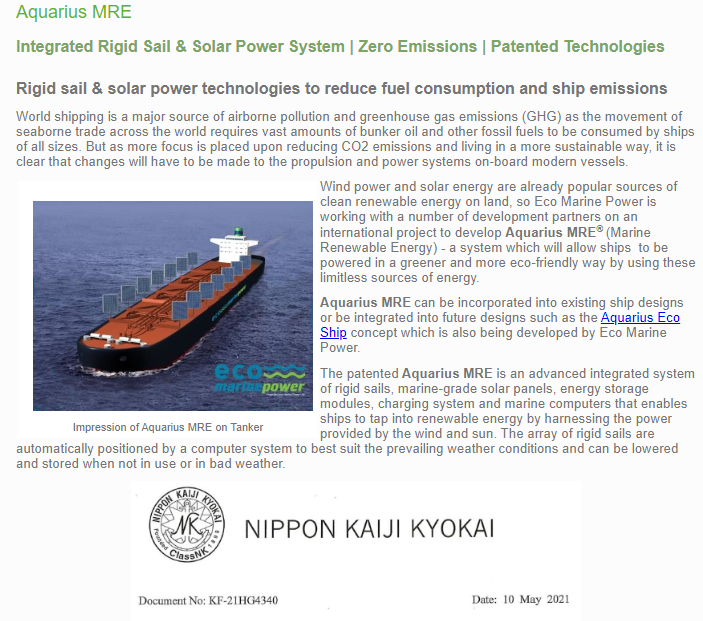
Aquarius MRE (Marine Renewable Energy) can be incorporated into existing ship designs or be integrated into future designs such as the Aquarius Eco Ship concept which is also being developed by Eco Marine Power.
Innovation for Low Carbon Shipping and Marine Applications
Author(s):
NA
Aquarius MRE (Marine Renewable Energy) can be incorporated into existing ship designs or be integrated into future designs such as the Aquarius Eco Ship concept which is also being developed by Eco Marine Power.
Power at sea: Towards high-performance seawater batteries
Author(s):
NA
Despite the many potential applications of seawater batteries (SWBs), the limited performance of available materials has hindered their commercialization.
Power at sea: Towards high-performance seawater batteries
Author(s):
NA
Despite the many potential applications of seawater batteries (SWBs), the limited performance of available materials has hindered their commercialization.
Lack of marshaling ports hindering offshore wind industry
Author(s):
NA
A new study finds that the existing and planned marshaling ports of USA, the assembly areas critical to building and deploying offshore wind turbines, will be insufficient by 2023 to meet commitments and will fail to meet projected demand through 2050.
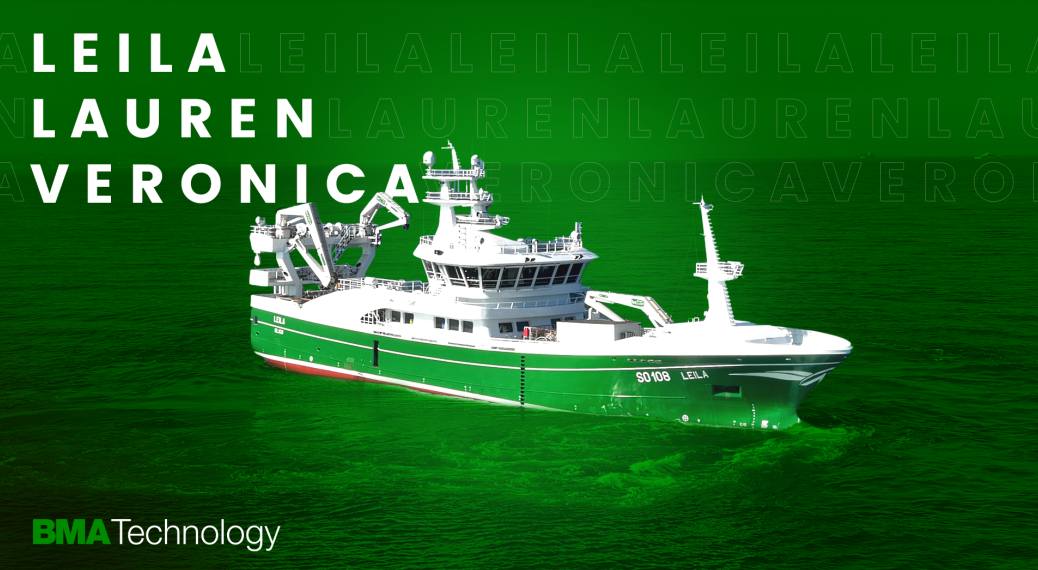
The vessels' multi-fuel methanol-electric propulsion system is one of its primary features, and A2B-online expects them to achieve emission reductions of up to 95%.
The vessels' multi-fuel methanol-electric propulsion system is one of its primary features, and A2B-online expects them to achieve emission reductions of up to 95%.
How tidal range electricity generation can protect coastal areas from flooding
Author(s):
NA
The research, conducted by Lancaster University, highlights the potential of tidal range schemes in protecting estuaries and coastal areas from the effects of sea level rise. The researchers argue that these schemes are essential to safeguard habitats, housing, and businesses from a rising sea level, which is estimated to be over one meter within 80 years
A multinational team of researchers, led by Assistant Professor Daejeong Kim from the National Korea Maritime & Ocean University, has recently studied the path-following performance of Maritime Autonomous Surface Ships (MASS) using a free-running computational fluid dynamics (CFD) model combined with the line-of-sight (LOS) guidance system, at low speeds under adverse
A multinational team of researchers, led by Assistant Professor Daejeong Kim from the National Korea Maritime & Ocean University, has recently studied the path-following performance of Maritime Autonomous Surface Ships (MASS) using a free-running computational fluid dynamics (CFD) model combined with the line-of-sight (LOS) guidance system, at low speeds under adverse
Shell’s first all-electric ferry launched in Singapore
Author(s):
NA
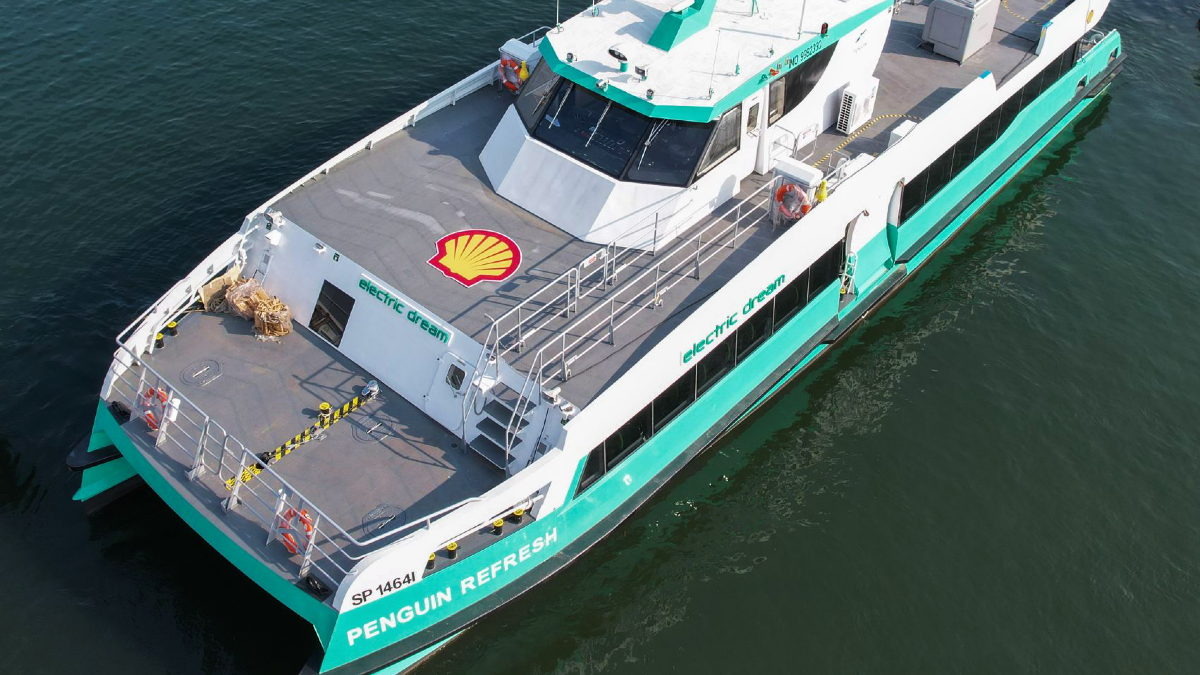
Singapore’s first all-electric commuter ferry, Penguin Refresh, was launched for Shell’s Energy and Chemicals Park on the island of Pulau Bukom. The 200-passenger, 21-knot electric commuter ferry is the first of three such vessels that will operate between Pasir Panjang and Shell’s Energy and Chemicals Park on Pulau Bukom
Sailing cargo ships can benefit from new aerodynamic tech
Author(s):
NA
A research team at Chalmers University of Technology has demonstrated a unique method that reduces the aerodynamic resistance of ships by 7.5 per cent. This could pave the way for large cargo ships to be propelled by wind alone, as wind-powered ships are more affected by aerodynamic drag than fossil-fueled ones