



A collaborative platform between Ministry of Ports, Shipping and Waterways (MoPSW) and The Energy and Resources Institute (TERI)
A collaborative platform between Ministry of Ports, Shipping and Waterways (MoPSW) and The Energy and Resources Institute (TERI)
A collaborative platform between Ministry of Ports, Shipping and Waterways (MoPSW) and The Energy and Resources Institute (TERI)
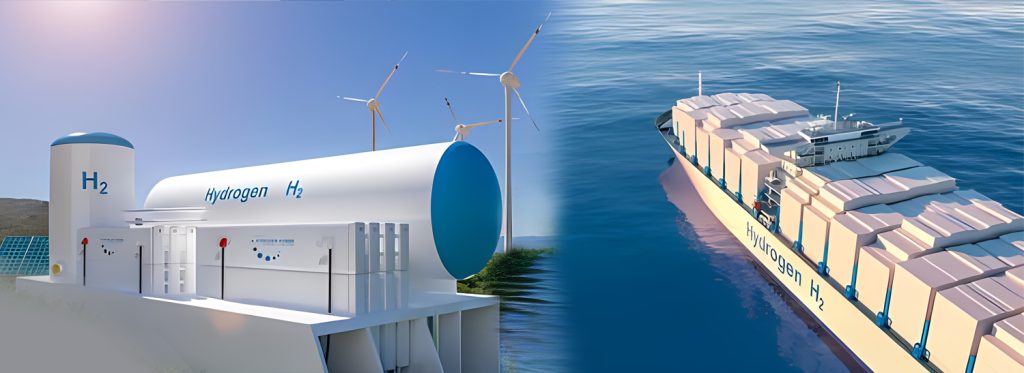
Hydrogen storage: Hydrogen is recognized for its silent operation, emphasizing both zero emissions and zero noise. In essence, fuelling it represents the energy source for future generations to thrive in a green environment. Hydrogen’s potential in shipping has been well recognized, however, there do exist barriers for utilization of hydrogen as fuel and hence it needs considerable research and experimental works because of its unique properties, and above all safety is the most serious concern associated with hydrogen. Hence, more testing is needed to overcome the challenges related to safety aspects of handling, storage, and bunkering hydrogen.
It is always suggested that the hydrogen technology should be adopted first for land-based transport and storage rather than experimenting directly in marine sector where if the things go sideways, the results could be catastrophic. Currently, two hydrogen storage methods exist: physical hydrogen storage (high-pressure hydrogen storage, liquid hydrogen storage, and cryo-compressed hydrogen storage) and chemical hydrogen storage (metal hydrides, liquid organic hydrogen carriers (LOHCs), carbon nanotubes, and metal-organic frameworks (MOFs). Storage and transportation of hydrogen are also significant factors, especially from the environmental perspective. Storage and transport (without construction) accounts for around 35.5% of the total GHG footprint of a hydrogen value chain (production, storage, transportation, and losses) if liquefied and transported via road transport instead of a pipeline.
Fuel Cell technology for marine shipping: The fuel cell technology unveiled the potential of hydrogen, availing to power the marine shipping cargo out turn to go green. In line with the various green initiatives in place, hydrogen and fuel cell technology are also drawing the attention for being used as an alternate fuel though there are lot of gaps to be filled in regarding ways and means of handling it in a safe and constructive manner.
Extensive research study is ongoing to determine which hydrogen fuel cells can be used as a primary shipping fuel in terms of available technology, cost-effectiveness, and aspects of storage and safety standards. Nearly 90% of the global trade is being progressed through maritime sector, where the massive consumption of fossil fuels which are less refined and rich in high-sulphur content are being incinerated for centuries. Therefore, the maritime sector by burning substantial quantities of fossil fuels is also fuelling the burning issues of global warming and climate change as there has an alarming surge in GHGs’ emissions, notably sulphur oxides, nitrogen oxides, and carbon dioxide.
The imperative factors while considering the hydrogen fuel cell technology as an alternate fuel are chiefly key technologies with reference to fuel cell-type selection, fuel cell hybrid system structure, and modelling and control of various hybrid systems, green hydrogen production from renewable resources, hydrogen storage and maritime hydrogen transport. In general, fuel cells usually work with other power sources to drive ships. A reasonable configuration can ensure system feasibility while the advanced modelling and control methods can bring out the system’s potential.
Adoption of an integrated approach is required for using hydrogen fuel cell technology in marine shipping applications, duly considering the above factors. National and international standards and guidelines shall be developed aimed towards increasing safety of hydrogen, especially in terms of its production, storage, and transport.